
Finding Bloomfield Residents
No single master resident list exists for Bloomfield. The right trail depends on the clue in hand. An address usually starts with the Assessor's parcel card and the Town Clerk's recorded-land index. A name can travel through the state voter lookup, court party search, professional-license database, probate case lookup, or unclaimed-property search. Past residents of Bloomfield belong in a different group of sources: Hartford-area telephone books, census schedules, newspapers, cemetery indexes, and Wintonbury Historical Society material.
Each record answers only its own question. An assessor card identifies a listed owner and parcel. A voter result shows registration and polling context, nothing more. A deed names parties to a recorded transaction, not everyone living in the building. A directory entry gives dated address or telephone evidence. A careful Bloomfield residents directory search compares two independent record families and keeps their dates and limits in plain view.
- Start with the strongest stable clue, such as a full name, street address, approximate year, spouse, business, or parcel ID.
- Use MapXpress to connect a name or address to an owner, situs, mailing address, Unique ID, map/lot, PID, and book/page.
- Test the person or entity in the Connecticut voter lookup, court portals, probate search, or state license system when that record fits the question.
- Use the Town Clerk deed index to confirm a transfer, legal description, grantor, grantee, or related lien rather than treating a property card as title.
- For an older resident, compare a dated directory, newspaper, census, cemetery, or house-history source, then ask the custodian for a certified or restricted record when needed.
Note: A public result can establish a record connection without proving that anyone currently lives at a particular Bloomfield address.
Bloomfield Resident Records Offices
Bloomfield sits inside Hartford County. Connecticut counties run no county recorder for ordinary land and vital records. The local junction is the Bloomfield Town Clerk at Town Hall. Land, vital, trade-name, election, and agenda records are indexed and preserved there. The Assessor and Registrar answer different questions entirely. The Hartford Judicial District and Tobacco Valley Probate Court handle court matters.
Always go to the office that owns the record. The Town Clerk can explain a book/page citation, a certificate route, a copy request, or a Freedom of Information handoff. The Assessor can walk through a parcel card and Grand List entry. The Registrar handles registration status and privacy procedures. State offices fill the gaps with statewide vital, court, license, correctional, and historical systems.
Bloomfield Town Clerk
Town Hall, 800 Bloomfield Avenue
Bloomfield, CT 06002-0337
860-769-3507
Bloomfield Assessor
Town Hall, 800 Bloomfield Avenue
Bloomfield, CT 06002
860-769-3530
Bloomfield Registrar of Voters
Town Hall, 800 Bloomfield Avenue
Bloomfield, CT 06002
860-769-3540
Walking into Town Hall is only one channel. The same offices work by mail, fax, and telephone. They also take written requests to the right custodian. Library reference desks and State Library and Archives appointments extend the reach of any Bloomfield resident lookup. Online indexes help too.
Note: The Town Clerk page lists cash and checks for general services. Individual record pages may state different payment instructions, so confirm before mailing.
The Bloomfield Town Clerk records page identifies the local counter and its preservation duties. It displays that records junction rather than a resident roster.
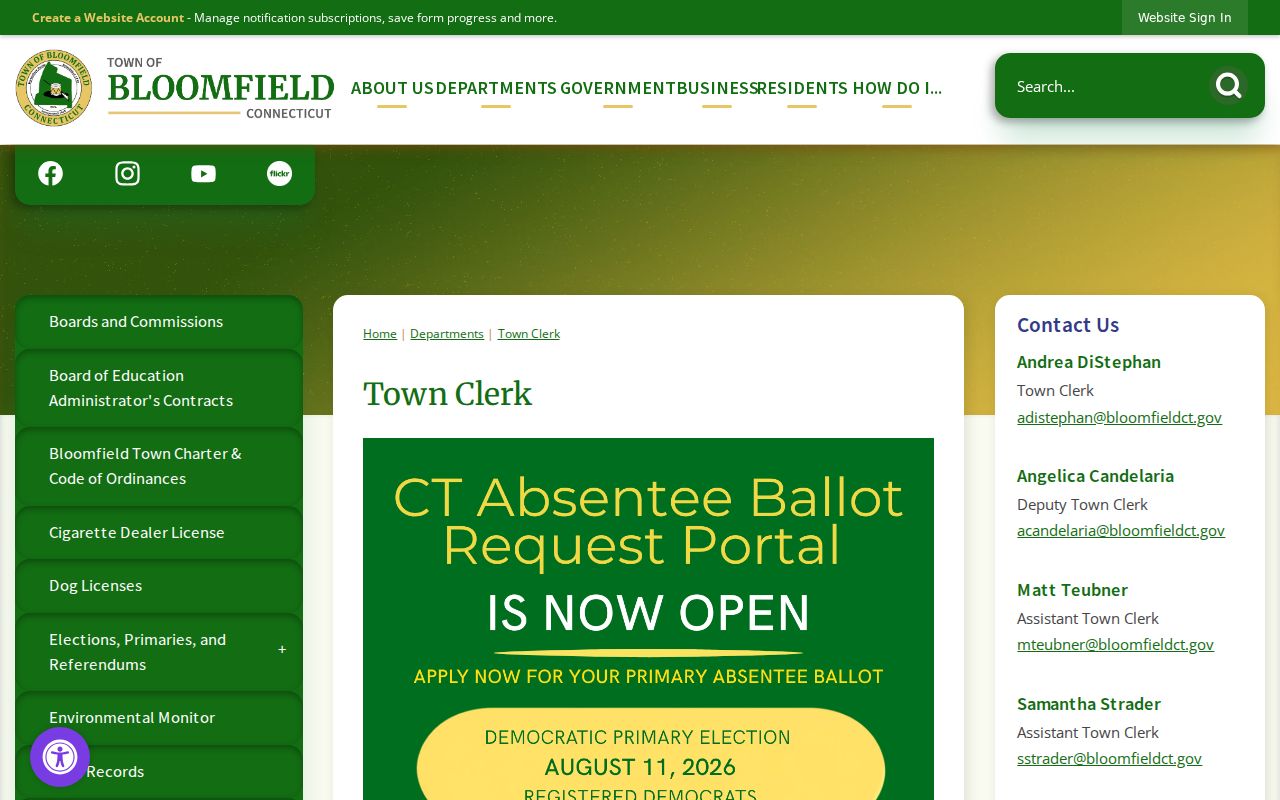
The clerk's duties explain why one counter can connect a deed question, a vital-record request, a trade name, and an FOI route, even though the underlying rules stay record-specific.
Bloomfield Assessor Owner Search
MapXpress is the fastest current bridge from a person or address to a Bloomfield parcel. Its main property screen takes a Property Search Name, House No, Street selector, or Unique Id. No ZIP field appears, so a ZIP-wide assessor search is off the table. Search one stable field first. Then use the card and map to test whether the result truly fits the question.
| Field | What to enter or expect |
|---|---|
| Property Search Name | Owner or business name; a useful first pass for a person or entity |
| House No | Street number for an address-led search |
| Street | Street selected from the portal’s list; walk one address at a time |
| Unique Id | Parcel identifier, useful when an address or owner name is unclear |
| Card details | Owner, mailing and situs/location addresses, map/block/lot, PID, acreage, zoning, book/page, and building facts |
The Bloomfield Assessor reports roughly 7,300 parcels with nightly updates. Its assessment process draws on prior Grand Lists, Town Clerk transfers, maps, permits, and inspections. Printed Grand Lists are organized by owner or business name. They are split into real estate, motor vehicle, and personal property. Connecticut assesses real estate at 70% of fair market value. Bloomfield's latest revaluation came in Fall 2024.
A card is a property clue, not a census of occupants. The mailing address is where tax correspondence goes and may differ from the mapped situs. Use the legal book/page, map/lot, PID, and legal description to bridge from the card to the recorded deed.
The Bloomfield property search page shows the address and owner route. That route anchors many Bloomfield residents directory questions.
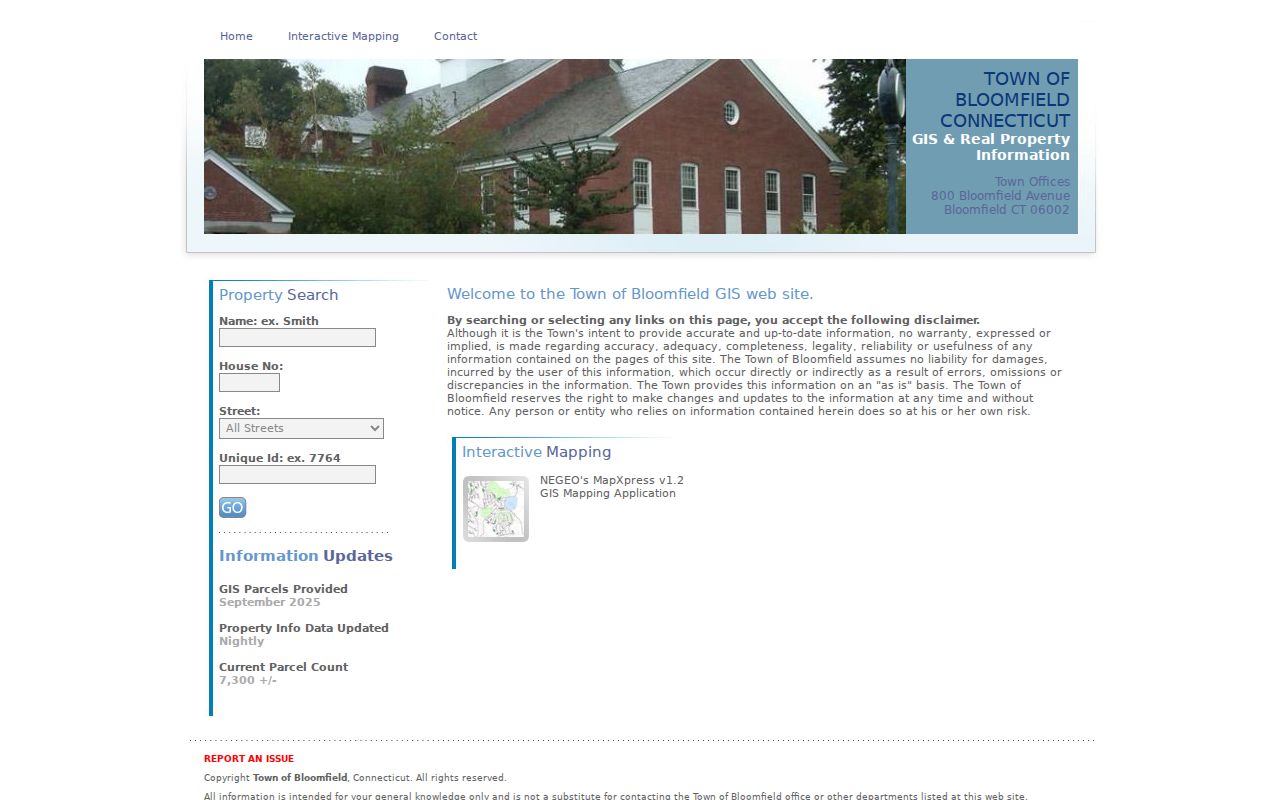
That first parcel result is strongest when paired with a deed, voter result, directory year, or other dated source rather than repeated as though it were a household list.
Bloomfield Deeds as a Resident Trail
Deeds give the Bloomfield residents directory its ownership backbone. The Town Clerk keeps a recorded-land index that reaches back to April 13, 1961, with linked images starting August 26, 1980. Searching is free. Watermarked viewing costs nothing, though printing or downloading a recorded document runs $2 per page and printed search results cost $1.50 per page. Anything older, whether bound books or microfilm, takes a question to the Town Clerk, the library, or an archives desk.
The search itself is simple. Enter a business or last name, add a first name if you have one, and pick Both, Grantor, or Grantee. A recorded-date range narrows things fast. Choose a document type only when it truly helps, because the index covers deeds, mortgages, releases, liens, easements, maps, probate certificates, trade names, tax-collector deeds, and correction instruments. Beware the spelling quirks, too. Labels like ACREEMENT, ADMENDMENT, CERTICATE, MISCELLANOUS, and SPEICAL W live in the raw data, so a failed type filter never proves a record is missing from this city directory of land.
- Party name and role: separates a grantor, the transferor, from a grantee, the recipient.
- Document type: distinguishes a deed, mortgage, release, lien, map, probate certificate, or correction.
- Recorded date: narrows the transaction window and helps compare multiple owners.
- Book/page and legal description: connect the index pointer to the image and test parcel identity when a street number changes.
The Bloomfield Land Records page sits behind every property result. It shows the separate deed path a lookup must travel. Keep one caution in mind. A recorded deed proves a transaction happened, not that the grantee lives there today, so treat it as one strand of a Bloomfield resident lookup rather than the whole answer.
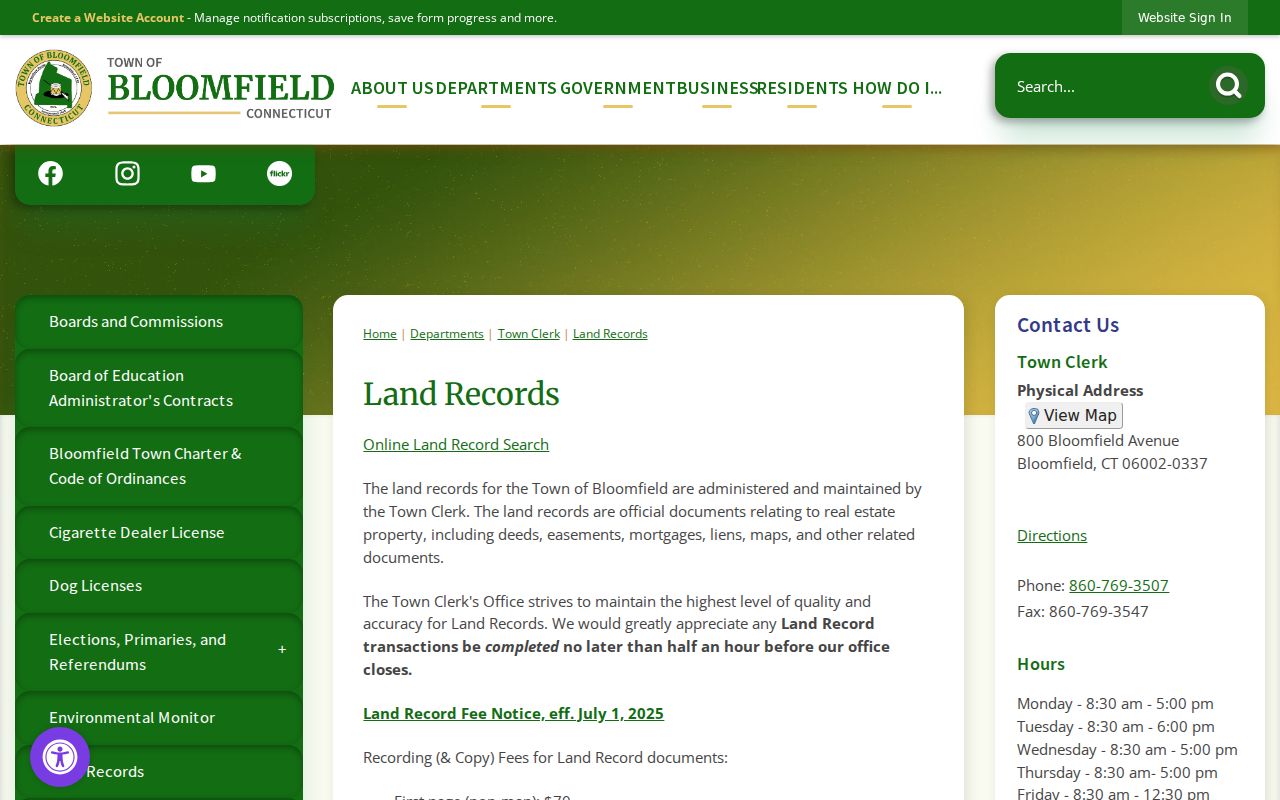
For a deeper address chain in Bloomfield, start with the current grantee and work back to each earlier grantor in the deed books. Then compare the legal description against the mortgage, release, map, probate, or tax-collector entry tied to the parcel.
Bloomfield Voter Lookup Records
Connecticut's official voter lookup works person by person. It is not a public street browser. Bloomfield's Voting Information page links to the state lookup. The Registrar of Voters keeps the local election records and administration. The form asks for Town, Last Name, First Name, and Date of Birth. When a record is public, it returns registration and polling context. The form's live display is best confirmed at the state page itself.
What the voter rolls release today is specific. Public entries can include name, residence information, party affiliation, district context, registration or election-history fields, and year of birth. Month and day of birth stay withheld. A statewide file request must go in writing to the Secretary of the State's LEAD office. It costs $300, paid before release. The state's 2026 voter-file lawsuit Q&A and the Attorney General's dismissal notice offer dated context. They never replace the ordinary free lookup for voter rolls.
- Town and name
- Choose Bloomfield, then enter the last and first name with the spelling used by the registration system.
- Date of birth
- The official lookup workflow uses a full date, while public releases show year only.
- Result
- Registration, polling, and defined election-history context, not a ballot choice.
The Connecticut voter lookup is the official route that Bloomfield's voting information page links to. That portal is the state access path, nothing more. It is not a complete list of Bloomfield residents.
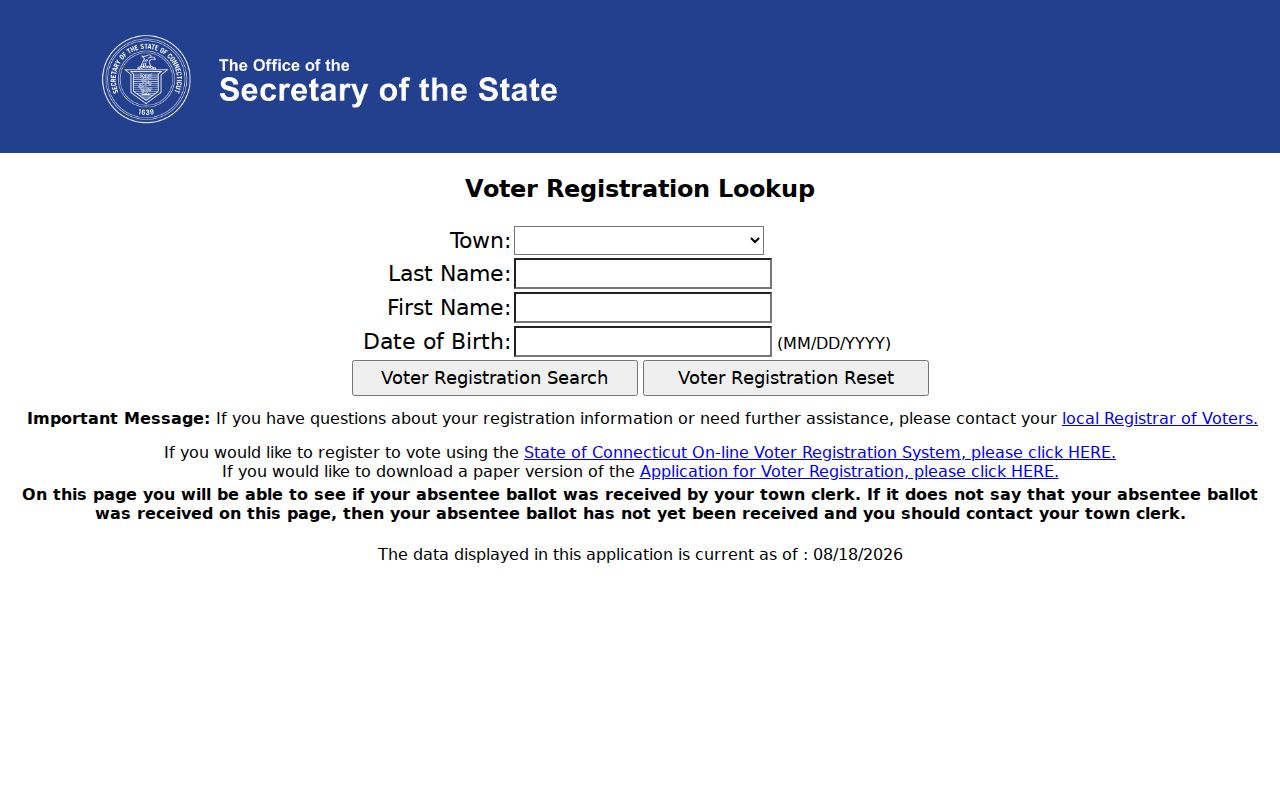
A missing result can mean many things. It might be a different town, a name variation, a changed record, a failed portal, a safety-based suppression, or the Voter Registry Privacy Program. Treat absence carefully in any voter-records search.
Current Bloomfield Resident Directories
Today's Bloomfield residents directory is really a set of partial sources. Each row answers a different question. The point is to keep ownership, registration, public office, and community membership from blurring into one another.
| Source | What it can show | Keeper | Access |
|---|---|---|---|
| Assessor card / Grand List | Listed owner, mailing address, parcel and property facts | Bloomfield Assessor | MapXpress and card route |
| Recorded-land index | Grantors, grantees, instruments, dates, and legal descriptions | Bloomfield Town Clerk | Free index; paid document copies |
| Voter lookup | Public registration and polling context for a named voter | Connecticut SOTS / Registrar | Defined lookup and file request |
| Court and probate indexes | Public case, party, estate, fiduciary, or docket leads | Judicial Branch / Probate | Online index plus clerk fallback |
| License and business portals | Credential, public business, address, and status clues | Connecticut agencies | Free state lookups; dynamic fields vary |
| Community and town directories | Officials, boards, organizations, and public contacts | Bloomfield offices | Online listings, no private roster assumed |
Official sources move slowly. They sit closest to the record custodian, though. Commercial people-finder profiles blend public extracts, old city directory volumes, marketing data, and third-party feeds, so they can merge names or cling to stale addresses. Treat them as a lead, never a substitute for the source records office.
| Route | Useful for | Check before relying |
|---|---|---|
| Town or state record | Current registration, title, case, license, or certificate question | Coverage, eligibility, date, redactions, and custodian |
| Library or historical collection | Past names, addresses, households, and community context | Edition, OCR, regional scope, and whether the entry is current |
| Commercial profile category | Generating a lead from mixed public and directory extracts | Same-name merges, stale data, fees, and lawful personal use |
Pick the tool that fits the question. A resident lookup workflow suits a search about one person. The street page fits an address clue. The city page fits evidence from a historical volume. A good record trail names what the source lists and what it cannot list. That honesty is what makes a Bloomfield residents directory useful.
Note: Bloomfield has no confirmed public municipal household directory. Community organization pages publish no street-by-street member roster.
Bloomfield Court and Probate Leads
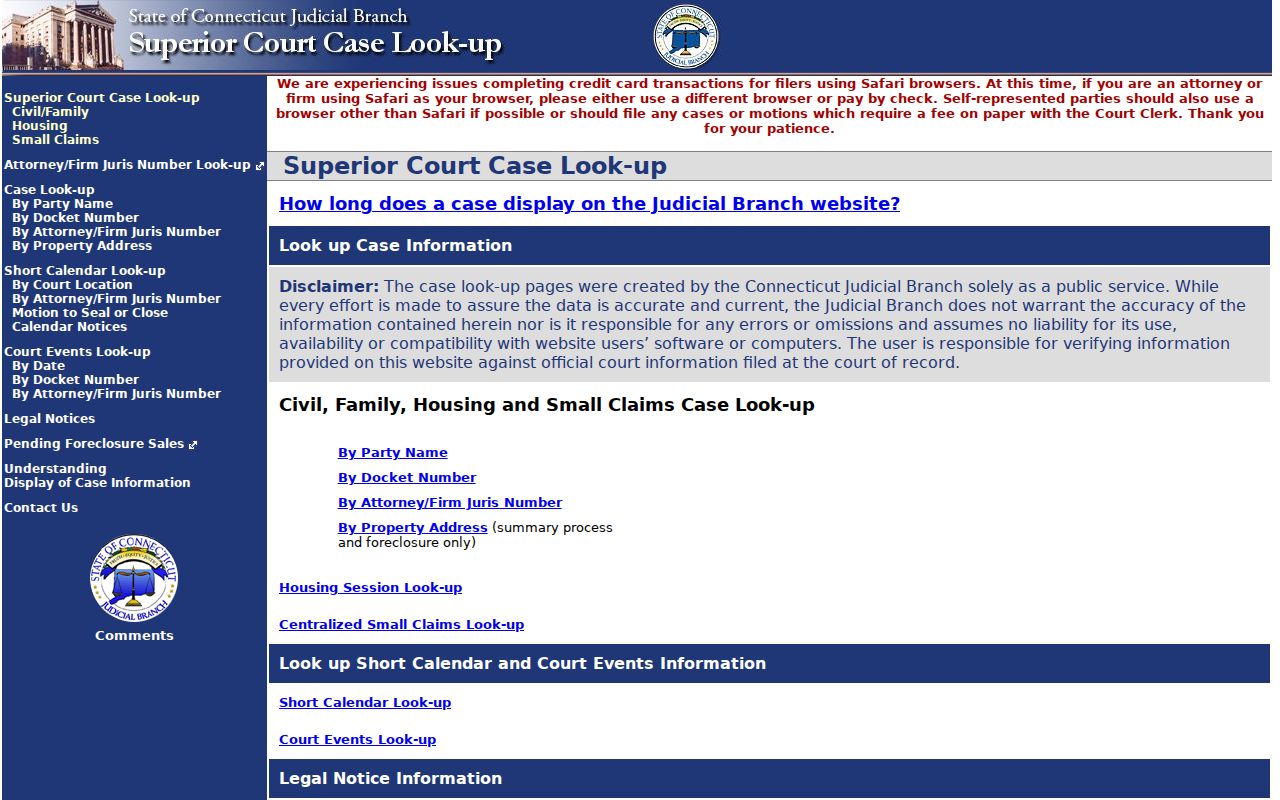
Bloomfield's ordinary civil and criminal cases belong to the Connecticut Superior Court Hartford Judicial District. It is not a Hartford County court. The civil inquiry offers several modes: party, docket, property-address, calendar, event, legal-notice, and foreclosure. A party search takes a last name, an optional first name, location, category, case type, and sort. It also allows Starts With, Contains, Is Equal To, or Sounds Like behavior. The criminal docket runs on its own fields. These include last name, first initial, birth year or a year range, location, and category.
Public case information can display a case name, docket number, file or return date, court, last action, parties, appearances, pleadings, motions, events, and disposition. The Judicial Branch's case-information explanation tells you how to read those fields. None of it is a certified court file. Civil and small-claims filings from January 1, 2014 are generally online. Older files, and many family, sealed, juvenile, erased, or protected matters, require the clerk. Others require a courthouse terminal.
The Connecticut civil inquiry portal shows the name-search route in its interface. A public hit is a lead, not identity proof. For an estate, guardian, conservator, trust, or heir question, turn instead to Tobacco Valley Probate Court District 3 in Windsor Locks. Its separate case lookup handles those matters.
Older Bloomfield names can reach even further back. State Archives material includes a Bloomfield Town Court record group covering 1875-1921, plus Hartford County Superior Court indexes spanning 1836-1951.
Bloomfield Vital Record Doors
Vital records here are not one open database. Local certificates come from the Bloomfield Town Clerk. Statewide registries belong to the Connecticut Department of Public Health State Vital Records Office. That office covers events beginning July 1, 1897. The state's record-request guidance walks through the available routes, along with applications and forms. Both state and town requests accept mail or in-person service. VitalChek offers an approved outside ordering route, with additional fees. State processing can run up to 12 weeks, while a town request is generally faster.
Connecticut shields birth records under 100 years old. The shield comes through General Statutes Chapter 93, including CGS §7-51. Exceptions cover family, legal, genealogical-society, and approved-research uses. Any person age 18 or older may obtain a certified death record. This is subject to statutory exceptions. Marriage certificates follow CGS §§7-51a and 7-74. Bloomfield's marriage-license page lists a $50 license fee and a $20 certified copy. Divorce decrees come from the Superior Court, not DPH. Adoption and original birth records move through confidential DCF or Probate channels. Those channels use forms such as DCF-3060, DCF-3061, and DCF-3062.
A copy request needs the requester's name and address. It also needs the subject's name, the event date and town, eligibility or relationship, photo ID, a signature, payment, and return instructions. Restricted records belong with their custodian. A lookup result is no substitute for the certificate.
Bloomfield License and Business Clues
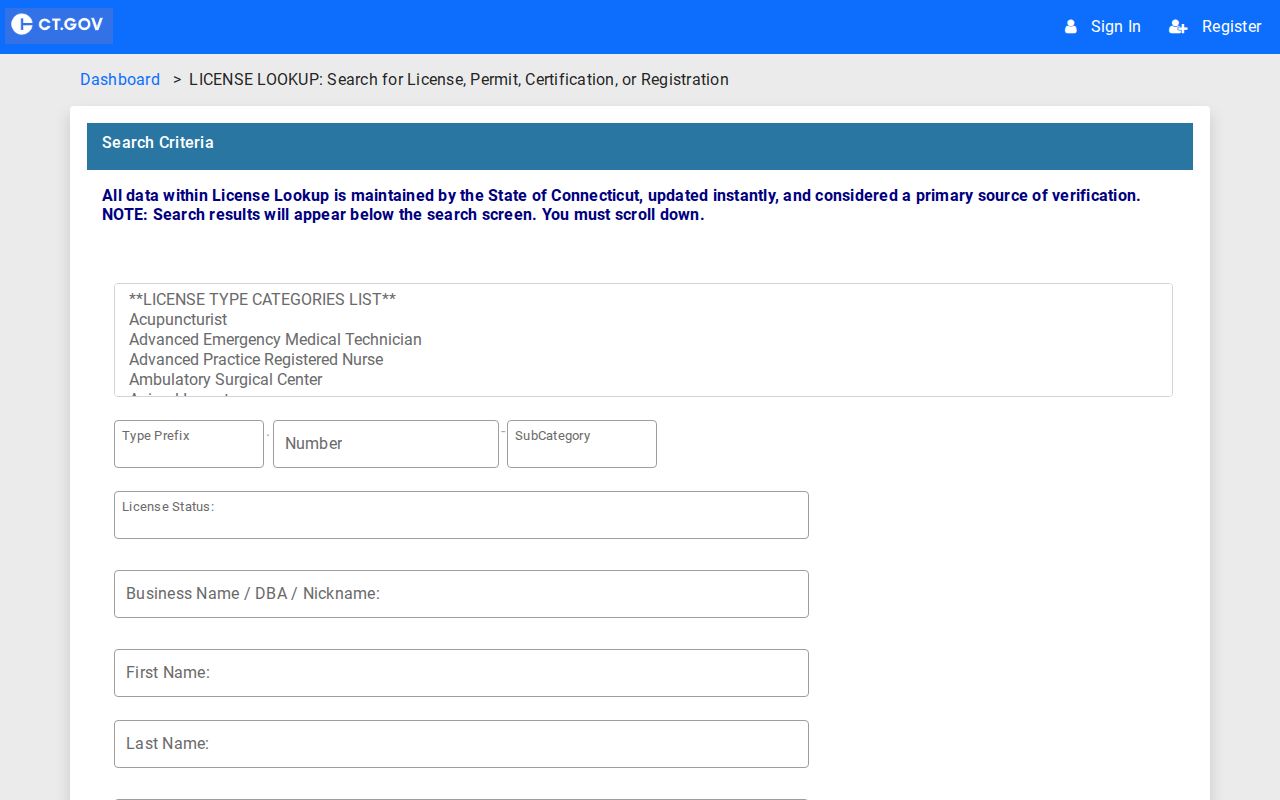
eLicense works well for named-person checks. It is a Connecticut tool for any question where a profession or credential matters. Visible fields include credential type, prefix, number, subcategory, status, business or DBA name, first and last name. Address, state, city, ZIP, and country also appear. The state maintains more than 850 credential types. Updates apply instantly. Dropdown options load dynamically, so confirm any result in the live state portal. Verify anything there.
Business.CT.gov splits business entities, UCC filings, trademarks, small-business searches, and certificates into separate services. Its online business search does not publish a fixed field set. So no exact result columns or ZIP search can be promised. Bloomfield trade names stay a Town Clerk route. CTBigList offers a free unclaimed-property search by last or business name. First name, city, ZIP, and Property ID also work. A claim still requires proof of identity or ownership.
The Connecticut license lookup page below shows what a credential search adds. It supplies a public affiliation, not a complete resident list. That distinction matters.
The Connecticut DOC inmate information page offers one state custody clue. It sits apart from court records. Youthful-offender and federal immigration detainee records are excluded. The Federal Bureau of Prisons locator is a separate federal route. It has its own coverage period. The Connecticut Sex Offender Registry is another distinct state route. It cautions that the state does not assess any individual's re-offense risk. The DOC link below marks an official path, not proof of a criminal conviction.
Use a license, business, unclaimed-property, or correctional result for the narrow record question it answers. Confirm it with the issuing office.
Bloomfield Privacy and Missing Results
Some Bloomfield results are missing by design. Connecticut's Address Confidentiality Program, called Safe at Home, gives eligible residents a substitute mailing address after qualifying safety threats. The Voter Registry Privacy Program is separate. It lets a person swear that disclosure endangers the person or family. It creates no substitute address and suppresses no other record types.
Other limits apply elsewhere. Birth and adoption records, sealed or juvenile court matters, protected-victim information, DMV personal addresses, utility customer lists, and some police investigative records each carry their own restrictions. The Connecticut Data Privacy Act grants qualifying residents rights to access, correct, delete, port, and opt out of certain covered data. It does not erase a municipal public record. A missing hit points to a lawful custodian question. Searching harder for hidden details is not the answer.
Use the record for a lawful personal purpose. Compare dates and roles, avoid sensitive identifiers, and never use a Bloomfield residents directory result to stalk, harass, intimidate, or harm a person.
Bloomfield FOI Request Fallback
Connecticut's Freedom of Information Act, Chapter 14, CGS §§1-200 through 1-242, is the documented fallback for non-exempt municipal records. Those records stay open unless an exemption applies. Section 1-210 covers inspection and copies. The FOI Commission's §1-212 fee guidance covers written, electronic, plain, facsimile, or certified copies. Municipal pages are capped at 50 cents. Electronic copies may carry actual costs. Section 1-206 requires written denials within four business days. A general 30-day appeal window runs to the FOI Commission.
Send each request to the right custodian. The Town Clerk holds land, vital, trade-name, and election material. The Assessor keeps parcel information. Building and Land Use handles permits. Police Records releasable location, type, and time-period records. Engineering/GIS map interpretation, and the Registrar voter administration. State and court records use their own form or clerk route. Ask for segregable or redacted material when part of a record is exempt.
- Name the record type, person or address, and date range as narrowly as possible.
- State whether electronic delivery is preferred and keep the sent request and delivery proof.
- Ask the custodian to identify any exemption and release non-exempt portions if the request is partly denied.
- For a denial, preserve the date and use the FOI Commission appeal route when appropriate.
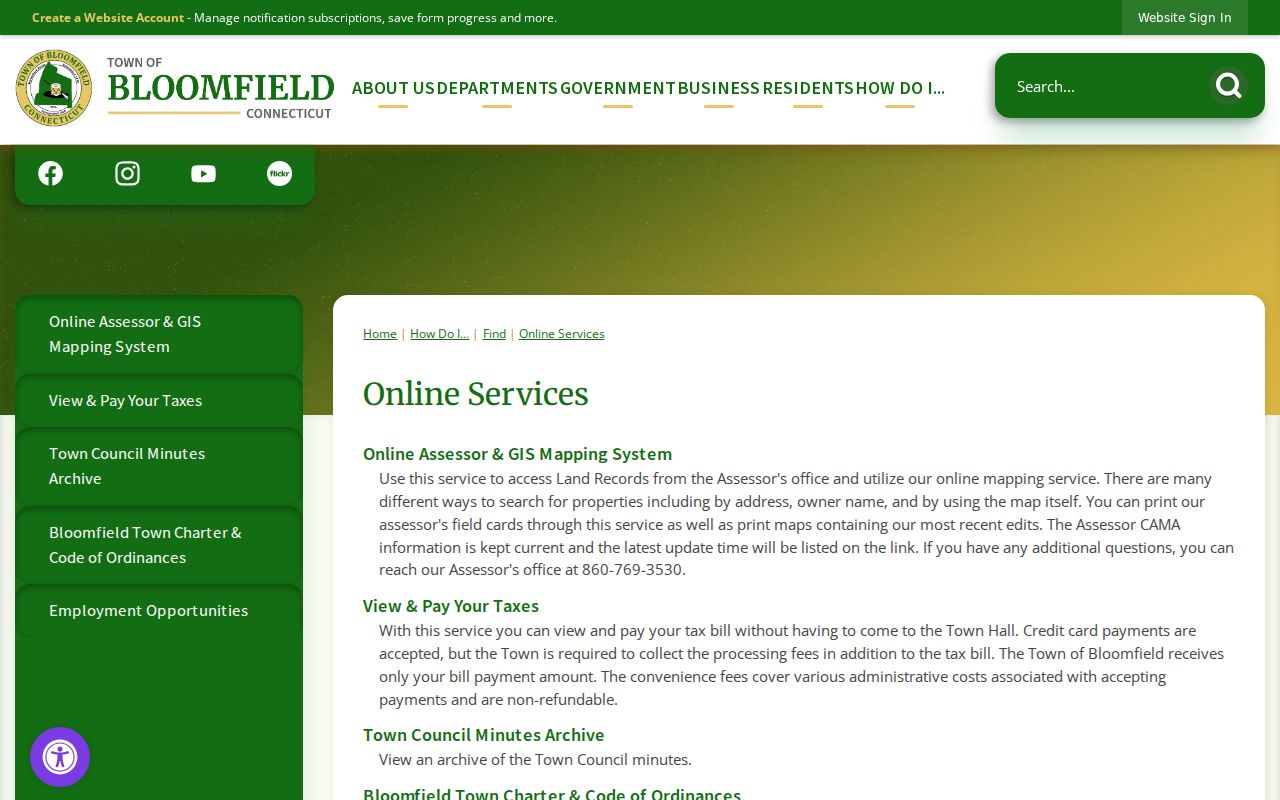
Start with the town's online services hub. It helps identify the current municipal system before a request goes out.
Note: FOI opens non-exempt public records only; it does not override vital, voter, DMV, sealed-court, juvenile, adoption, medical, or investigative restrictions.
Bloomfield Address Roles
A single address can play several parts in a Bloomfield record. The situs address marks the physical parcel. The Assessor, GIS, building, and fire systems all rely on it. A mailing address simply receives tax correspondence. The legal description pins land to a deed. A voter residence serves an electoral purpose. A directory address shows where a person or business was listed at a given time. A ZIP, meanwhile, is delivery geography, not a municipal boundary.
- Parcel
- A mapped unit of land identified by a Unique ID, map/lot, PID, or legal description.
- Index
- A searchable pointer to a record, such as a deed entry, not always the full certified image.
- Roll
- A recurring official list, such as an Assessor Grand List or voter registry, with its own eligibility and update rules.
- Criss-cross directory
- An address-to-name or name-to-address directory, usually historical and incomplete.
A parcel owner is not always the person living there. A deed, tax roll, or probate file proves ownership only, while a telephone listing shows who paid for service, not necessarily who occupies the house today. Keeping owner, occupant, mailing address, and court address straight keeps a Bloomfield residents directory search from turning one kind of record into a claim it cannot support.
Historical Bloomfield Resident Directories
Researching past residents of Bloomfield means working from regional collections rather than town-bound ones. The Library of Congress holds Hartford-area telephone directories spanning several decades. Verified editions include 1926/27-28, 1954, 1958, 1960/61, 1962/63, 1971/72, 1972/73, and 1974/75. An entry may list a name, an initial, a telephone number, a street, and an occupation or business. The regional abbreviation “Bimfld” is often attached to these listings. OCR frequently mangles surnames. Always check the page image before trusting a transcription.
Closer to home, Bloomfield Public Library provides Ancestry Library Edition. Its Hartford Courant coverage reaches back to 1764. researchIT CT, catalog help, and historical links round out the offerings. The Wintonbury Historical Society holds Filley and Pinney genealogy files. Cemetery indexes, local publications, and house histories sit there too. The State Library’s History & Genealogy Unit can connect court, vital, census, map, probate, and individual-name material. Its State Archives serve the same purpose. One gap remains: the public library page publishes no complete shelf list. Ask the reference desk which printed and reverse-directory years sit in the building.
Used together, these dated sources make the Bloomfield residents directory a real tool for family history. It carries no pretense of being current. Pair a telephone or city directory with a census year, deed, obituary, cemetery inscription, or house-history report. Corroboration across records is the goal. For modern address work, continue to the Bloomfield street directory. For collection details and help reading entries, use the Bloomfield city directory page.