
Bloomfield Previous Residents: Source Eras
A house history needs more than one kind of record. Bloomfield’s land index is the strongest modern ownership starting point, while telephone books, census schedules, Grand Lists, permits, newspapers, and local history sources help explain who was present at different times. The table separates coverage that is verified from collections whose exact local run still needs a library or archive check.
| Source | Years it covers | Where held | What it shows |
|---|---|---|---|
| Bloomfield recorded-land index | April 13, 1961 to present | USLandRecords and Town Clerk | Grantor, grantee, instrument, date, book and page; images begin August 26, 1980 |
| Recorded document images | August 26, 1980 to present | USLandRecords; earlier books by custodian request | Legal description, signatures, acknowledgments, attached maps, and related instruments |
| Hartford-area telephone books | 1926/27-28, 1954, 1958, 1960/61, 1962/63, 1971/72, 1972/73, 1974/75 examples | Library of Congress and library reference collections | Name, address, phone, occupation or business, and regional abbreviation |
| Federal census schedules | 1790-1950 released history under the 72-year rule | National Archives and library databases | Household members, ages, relationships, birthplace, and occupation |
| Printed Grand Lists | Bound by year; full online historical run not located | Bloomfield Assessor | Owner last name or business name, mailing address, and tax-list context |
| Building permits | Current Viewpoint Cloud route; start year not located | Building and Land Use or FOI custodian | Construction, alteration, applicant, owner, inspection, and date when released |
| Wintonbury house history | 108 Tunxis example reaches from 1776 through 1951 and later development | Wintonbury Historical Society | Transfers, adjoining owners, railroad references, road development, and oral history |
| Cemetery, obituary, and probate sources | No single Bloomfield run verified | WHS, BPL, court, and probate offices | Death, burial, heirs, family links, and a last known address |
Start with the era that matters. For a recent transfer, use the parcel card and deed index. For a mid-century household, pair a Hartford-area telephone book with a census release. For a pre-numbering road description, use adjoining owners, maps, and a local house history before assuming that a modern address search failed.
Bloomfield Previous Residents Through Deeds
Begin with the current MapXpress parcel card, not a name-only search. Record the owner, mailing address, situs or location, Unique ID, map or block and lot, PID, acreage, land use and class, zoning, book and page, building facts, and any unit designation. The Bloomfield property search is a current tax-record clue. The mailing address may be elsewhere, and the card is not a complete occupant list.
Next, use the local recorded-land index. Search the current owner as grantee, open the likely purchase instrument, capture the seller and legal description, then search that seller as an earlier grantee. Repeat the loop until the legal description changes or the online index ends. Search a business, trust, estate, or spelling variant when the chain changes names. The Connecticut deed-copy warning is a useful reminder to verify fees and sources with the Town Clerk before paying a private mailing.
- Copy the parcel identifiers and the exact situs spelling from the current card.
- Search the current owner as grantee and narrow by a likely date and deed type.
- Read the seller or grantor, buyer or grantee, recording date, book and page, and prior instrument reference.
- Search the seller as grantee in an earlier date range. Use the legal description instead of the street address when the text changes.
- Add mortgages, releases, assignments, liens, maps, probate certificates, tax-collector deeds, foreclosure instruments, correction deeds, easements, and trade names when they explain a gap.
- Pair each title event with a directory, census, obituary, cemetery, or probate source before describing a person as a past occupant.
- Grantor and grantee
- The grantor conveys an interest or right. The grantee receives it. In a purchase deed, the seller is usually grantor and the buyer is grantee.
- Chain of title
- The linked sequence of recorded transfers and related instruments that connects a parcel’s present record to earlier holders.
- Legal description
- The recorded land description using a map, lot, bounds, or other parcel language. It can identify the same land after a street name or number changes.
- Criss-cross directory
- An address-to-name reference used to work from a street or house back to a listed person. The exact Bloomfield run is not published on the library’s public page.
Bloomfield Previous Residents and Old Roads
Street names can hide a continuous property story. The Wintonbury Historical Society’s former street-name concordance connects present roads to older names, but exact rename years are not printed. No official E911 conversion table or house-number crosswalk was verified. Treat each pairing as a research clue, then confirm it through the deed’s legal description, map and lot, or an adjoining owner.
- School Street appears with Barber Road.
- Burr Road appears with South Burr Road.
- Gun Mill Road appears with Wilcox Road and Hoskins Road.
- Blue Hills Avenue appears with Granby Turnpike.
- Cottage Grove Road connects to Gillett Street, Mount St. Benedict Avenue, and Pipe Swamp Road.
- Newberry Road and Terry Plains Road connect to Old Windsor Road.
The 108 Tunxis house-history example shows why an adjoining owner can matter. Before modern street numbers were dependable, a transfer might be described by a farm, a boundary, or a neighbor. Search old and new names together, then compare the parcel map with the deed. A guessed rename date is weaker than a matching legal description.
Bloomfield Resident Records: 1961 and 1980
Bloomfield’s online land system has a clear split. The index reaches April 13, 1961 to the present, while document images begin August 26, 1980. Free searches and watermarked views can reveal the party and instrument path. A document print or download costs $2 per page, and printed search results cost $1.50 per page. Check the certification dates because new recordings are added continuously.
When an address history reaches before 1961, the lack of an online image is not a dead end. Ask the Bloomfield Town Clerk about earlier books, microfilm, and copy procedures. The public record route also includes library reference work, the State Library, the State Archives, and the Wintonbury Historical Society. Connecticut’s town-based system means there is no Hartford County recorder to substitute for the local custodian.
Note: A missing online document usually marks a coverage or access boundary, not proof that no earlier owner or transfer existed.
Bloomfield Resident History at 108 Tunxis
One Wintonbury Historical Society report shows how a local house history can join several record systems. The 108 Tunxis house-history PDF follows recorded transfers, adjoining-owner clues, road descriptions, railroad references, later development, and oral history.
The report begins with Elihu Mills in 1776, follows George Rathbun in 1870, Emily Cummings in 1907, Dr. H. Bailey, William Robinson in 1942, and Russell Isham in 1951, then continues into later subdivision and Wyndemere Road development. The names and dates are useful because they are tied to a documented house narrative, not because they form a current resident list.
The report also shows the value of adjoining owners and personal recollection. A deed may establish a transfer while a newspaper, railroad reference, or oral-history note explains how the land was used and who was remembered there. That combination is a strong model for Bloomfield previous residents research, especially when a road was not numbered the way it is today.
Bloomfield’s record-keeping story reaches back to Messenger’s Farm, Wintonbury Parish, and the town’s incorporation in 1835. The Wintonbury name remains a practical search term in older histories and local collections, just as a former road name can connect a present parcel to an earlier description.
Bloomfield Previous Residents in Directories
The Library of Congress has Hartford-area telephone books with verified examples from 1926/27-28, 1954, 1958, 1960/61, 1962/63, 1971/72, 1972/73, and 1974/75. The 1971/72 scan can show a surname, given name or initial, street, phone exchange, business or occupation, and a Bloomfield abbreviation such as “Bimfld.” OCR may join columns or misread a name, so the page image should control.
The Bloomfield Public Library genealogy resources page lists Ancestry Library Edition, the Hartford Courant archive, researchIT CT, catalogs, and local-history links. Ancestry is available on library computers or library Wi-Fi. The Courant archive is described as reaching from 1764 to the present, with in-library access and remote access for Bloomfield library-card holders. Ask the reference desk for printed city directories, reverse directories, funeral notices, and obituary indexes because the public page does not list an exact shelf run.
A directory entry is evidence of a listing at one time. It may be absent, stale, business-only, unlisted, or tied to a phone shared by more than one person. For the broader collection history and how to read an entry, use the Bloomfield city directory collections page, then return to the address chain rather than treating the directory as a deed.
Bloomfield Directory and Census Pairing
Directories and census schedules answer different questions. A telephone book can place a name and phone at a street address between census years. A census can distinguish same-name people through age, relationship, birthplace, household size, and occupation. The 1950 census is the latest fully released decennial schedule in the research record; later schedules follow the federal 72-year release rule.
Use this process when the goal is a household history rather than a title history:
- Normalize the present address against the Bloomfield former-name list and the parcel’s legal description.
- Choose a Hartford-area telephone book near the decade being studied and inspect the image, nearby entries, and abbreviation key.
- Pair the listing with the nearest released census year, checking age, relationship, birthplace, and occupation for same-name problems.
- Compare the address and names with the deed chain, Grand List, newspaper archive, cemetery index, or probate file.
- Write down what each source proves and what it cannot prove. A household entry is not title evidence, and a deed is not a complete household roster.
State Library guides can bridge census, maps, naturalization, military, probate, and old-house research. FamilySearch and library databases may provide an image or catalog lead, but an index hit should be checked against the original page when possible.
Note: A directory year can narrow a household search, but a released census schedule should be read beside the original page.
Bloomfield Records, Maps, and Permits
Sanborn fire-insurance maps can become useful when an exact Bloomfield item is found. The Library of Congress Sanborn research guide explains how to search by state, city, edition date, sheet count, place name, digitization status, and image link.
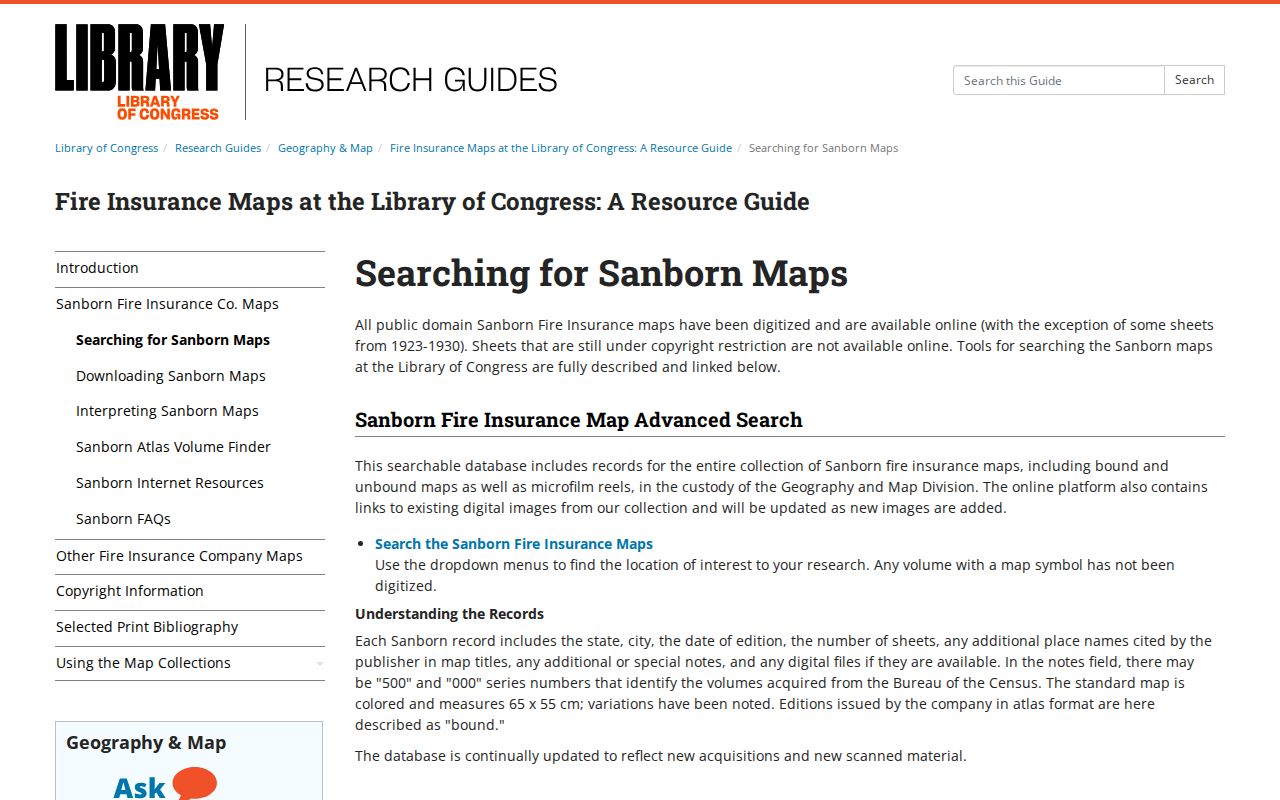
The guide can help identify a building footprint, material, use, height, street number, hydrant, water-main, and block setting once a verified Bloomfield map item is located. No Bloomfield-specific Sanborn year was verified in the research, so none should be inserted into an address history by guesswork.
Building permits offer a different time marker. The current Viewpoint Cloud route may hold construction, alteration, demolition, and inspection details, but public address fields were not exposed in the inspected view. The Bloomfield Building and Land Use page is the starting point. For older files, ask the custodian or make a narrow FOI request for the address, record type, and date range.
Bloomfield Probate and Obituary Records
A deed may end with an estate, trustee, or family transfer. Bloomfield belongs to Tobacco Valley Probate Court District 3, and the Tobacco Valley Probate Court is the proper district route for estates and related files. The statewide probate lookup is a free starting index, but its dynamic fields and exact result columns were not fully exposed in the inspection. Use the clerk for file access, certified copies, and restrictions.
Probate can identify a fiduciary, heir, will, order, or last known address in a public portion of a file. It does not open confidential medical or protected material. Obituaries and cemetery records can explain when a person left an address or connect a family to a burial place. Wintonbury’s historic cemetery work includes Old Wintonbury, Latimer Hill, Mountain View, Old St. Andrews, and Mount St. Benedict, while the Hartford Courant archive is the strongest identified newspaper route.
The Connecticut State Library judicial-record guide also lists Bloomfield Town Court records from 1875 through 1921. The State Archives and History and Genealogy Unit can explain the record group, index, volume, and on-site access. That rare local court lead can add names when a modern deed trail begins too late.
Access channels vary by source. Use the Town Clerk counter or phone at 860-769-3507 for local land and vital-record questions, the Prosser or McMahon library reference desks at 860-243-9721 and 860-242-0041 for directories and newspapers, and the State Library History and Genealogy Unit at 860-757-6580 for older collections. Probate questions go to 860-627-1450. Mail or FOI requests should name the record, address, date range, and preferred copy method, and the Archives advises researchers to call before travel when an off-site group may be unavailable.
Note: Call ahead before an archive visit because off-site record groups may have temporary access limits.
Bloomfield Resident History, Lawful Use
House history is strongest when it stays tied to the home, the record, and the era being studied. A recorded owner is not automatically an occupant. A directory listing is not title. A missing voter, court, or vital result may reflect a privacy rule, a sealed record, a name variation, or a gap in online coverage. Keep current personal details out of a public narrative unless the custodian has clearly made them available for that purpose.
House-history use. Research into past Bloomfield households is appropriate for genealogy, preservation, family history, and lawful personal curiosity. Do not use a name, address, image, or record trail to stalk, harass, intimidate, or track a living person.
When the research question changes from who lived at one house before to who is associated with an entire road today, use the Bloomfield street directory address workflow. Preserve the source date, identify whether the source shows ownership or occupancy, and ask the Town Clerk, library, historical society, court, or archive when an original record is needed.