
Bloomfield City Directory Holdings
The first local stop is the Bloomfield Public Library genealogy and history page. It points researchers to Prosser Library at 1 Tunxis Avenue and McMahon Wintonbury Library at 1015 Blue Hills Avenue, along with licensed databases, catalogs, and local-history help. The public page does not publish a complete shelf list, so a reliable search begins with the reference desk rather than an assumed publisher series.
| Collection | Years | Where Held | Access |
|---|---|---|---|
| BPL local-history and reference holdings | Exact print and reverse years not published | Prosser and McMahon Wintonbury | Ask the desk; catalog and reference access |
| Hartford-area telephone directories | 1926/27-28, 1954, 1958, 1960/61, 1962/63, 1971/72, 1972/73, 1974/75 examples | Library of Congress digital collection | Free scans and OCR |
| Geer's Hartford directory | 1860-1861; Bloomfield inclusion unconfirmed | FamilySearch digital books | Inspect the page, do not assume local coverage |
| Wintonbury Historical Society publications | 1935, 1965, 1983, 1992, 2001, 2009, 2011 examples | History Center, 153 School Street | Contact society; local books, families, and cemeteries |
| State Library and Archives indexes | Hartford County Superior Court 1836-1951; Bloomfield Town Court 1875-1921 | 231 Capitol Avenue, Hartford | On-site research; ask before travel |
The gaps are part of the evidence. No authoritative first or last Bloomfield-only directory, complete Polk run, or full reverse-directory shelf list was located. The verified material is regional, mixed in format, and uneven by year. Ask for Bloomfield and Hartford holdings, the address-to-name or criss-cross volumes, and any microfilm or reference copies before treating a missing year as a publication break.
Where Bloomfield Directory Research Begins
Prosser Library can be reached at 860-243-9721, and McMahon Wintonbury Library at 860-242-0041. The library resource page says Ancestry Library Edition is free on a library computer or library Wi-Fi. Its coverage includes census, vital, immigration, family, military, court and legal material, directories, photographs, and maps. Those databases help when a printed volume gives only a surname, an initial, or an address that has since changed.
The Hartford Courant digital archive is another strong local bridge. Bloomfield Public Library describes coverage from 1764 to the present, with in-library use for patrons and remote access for Bloomfield cardholders. researchIT CT adds a free Connecticut library service with genealogy and newspaper resources. Use the catalog and reference desk to ask for the exact directory, reverse directory, microfilm, obituary, or local newspaper item rather than assuming that a general search result covers Bloomfield.
The library page also links to the Connecticut State Library, Connecticut Archives Online, FamilySearch, the National Archives, and cemetery resources. A library card, a surname, a street variant, and an approximate decade give the desk enough to narrow the right shelf.
The library's genealogy resource list shows why Bloomfield research often needs more than one catalog record.
The library image belongs beside the practical first step: ask staff which local volumes are actually held, then use the digital databases to fill the years the shelf does not cover.
Hartford-Area Directories and Bloomfield
Regional telephone books are the clearest verified run for older Bloomfield names. Library of Congress examples include an item from 1926/27-28, January 1954, March 1958, 1960/61, 1962/63, 1971/72, 1972/73, and 1974/75. The books cover Hartford-area service rather than presenting themselves as a town-only roll. Bloomfield can appear in the locality line as “Bimfld,” and older street abbreviations can hide a match from a plain modern-address search.
Free scans and OCR make a surname search quick, but the image is the final check. The January 1954, March 1958, 1960/61, and 1962/63 scans help anchor the broader run. Two-column pages can confuse OCR, and a phone listing may be unlisted, outdated, business-only, or shared. Compare the surname, middle initial, street, locality mark, and nearby entries. A directory entry is historical evidence of a listing, not proof of current residence or title to land.
The FamilySearch Geer's Hartford volume from 1860-1861 is useful as a lead, but the available research did not confirm Bloomfield inclusion. Check the scanned pages and title geography before attaching an entry to a Bloomfield family.
When a dated listing needs a present-day check, the Bloomfield resident lookup workflow separates a historical phone address from a current public record.
The FamilySearch Hartford directory scan is best treated as a page-level question, not as an automatic Bloomfield hit.
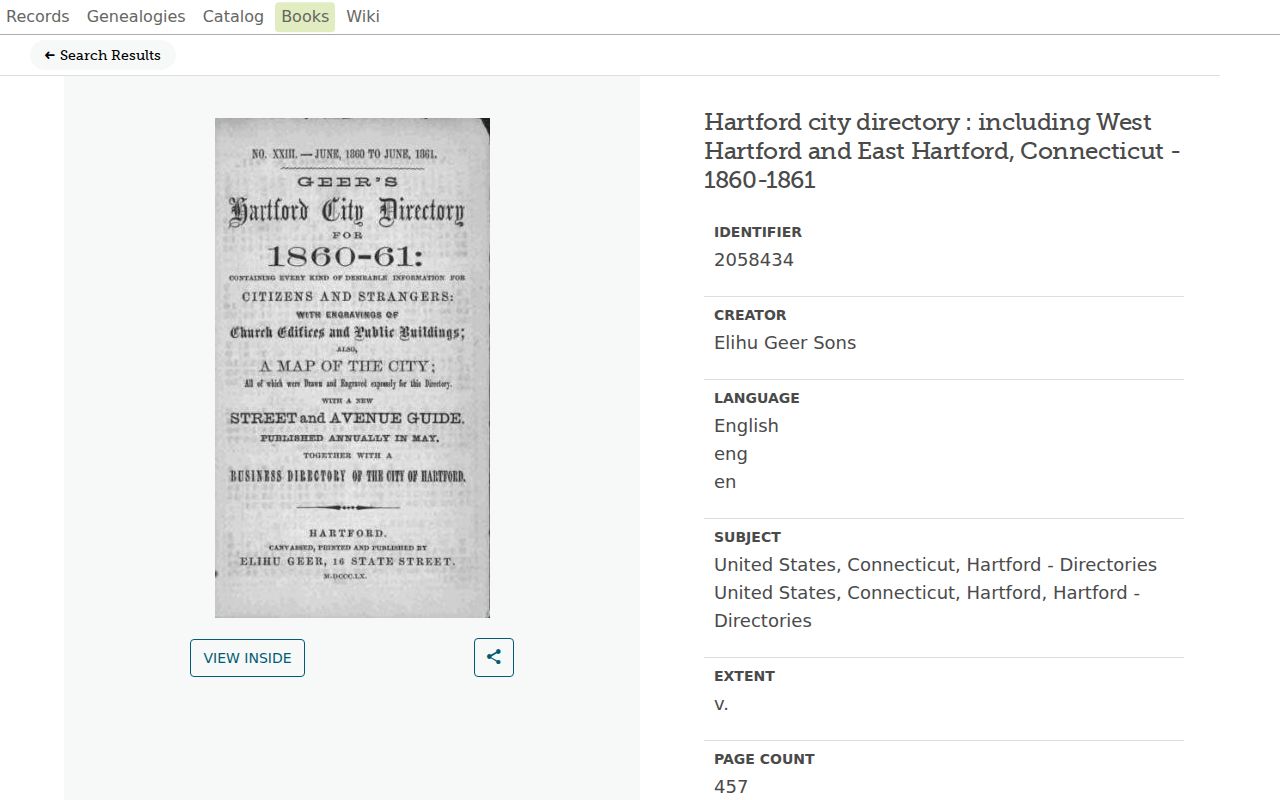
The image reinforces the need to read the volume's own place coverage before using a nineteenth-century name as local proof.
Reading a Bloomfield Directory Entry
A Hartford-area directory entry is short, but each mark can matter. A captured OCR example reads like “Barber Kenneth S 10 Maple Edge Dr Bimfld.” Verify that line against the page image before quoting it. The surname and given name point to the alphabetic file; the middle initial helps separate same-name people; the street line gives a place to test in a map, deed, or census.
| Name | Surname, given name, and a middle initial when printed |
|---|---|
| Address | House number and street, with an old locality or road abbreviation |
| Telephone | Exchange and number when the scan preserves the line |
| Household note | Spouse, widow, boarder, or related notation when that volume uses it |
| Occupation or business | A historical context line that may help distinguish two people |
| Owner or renter mark | Use only when the specific volume prints a clear symbol or label |
- Criss-cross directory
- A street-order section that lets a researcher work from an address toward a name.
- Householder index
- An index organized around the principal household name, where a volume provides one.
- Abbreviation key
- The volume's guide to shortened streets, towns, exchanges, and other marks; check it before reading OCR.
- Index versus image
- OCR is a finding aid. The scanned page controls when letters, columns, or punctuation are unclear.
Do not assume that every run marks ownership, renters, spouses, or occupations in the same way. Record the volume, page, date, and exact wording so a later reader can repeat the search.
Bimfld, Street Names, and Bloomfield Directories
Old road names can be as important as old surnames. The Wintonbury street-name material connects School Street with Barber Road, Burr Road with South Burr Road, Blue Hills Avenue with the Granby Turnpike, and several current roads with earlier paths or turnpikes. Simsbury Road and Bloomfield Avenue also appear with older forms such as Bissel Street, Main Street, Hartford Avenue, and Tunxis Avenue.
The exact rename years and a complete house-number crosswalk were not located. That means a failed address search is not a reason to discard the family. Try the current street, the historical street, the locality label, and the legal description. A directory's “Bimfld” may sit beside a street name that no longer appears on a town map.
For modern parcel work, the Bloomfield street directory follows the address chain through the assessor, GIS, and Town Clerk land index. Historical volumes should stay focused on what they actually show: a dated name, place, and listing context.
Note: Keep a small concordance of every street spelling, because one old road name can connect a directory, deed, newspaper notice, and cemetery record.
Bloomfield Directory Companions
The Wintonbury Historical Society adds the local texture that a telephone page cannot. Its History Center is at 153 School Street, and its publications include Over Tunxis Trails from 1935, 1965, and 2011; From Wintonbury to Bloomfield from 1983; The Good Old Days from 1992; Images of America: Bloomfield from 2001; and Bloomfield and the Civil War from 2009. These works connect names with roads, buildings, oral history, and civic life.
The society's genealogy route includes Filley and Pinney family material. Its historic-cemetery pages identify Old Wintonbury or Old North, Latimer Hill, Mount St. Benedict, Mountain View or West Hill, and Old St. Andrews resources. A cemetery index or local history book can explain why a person vanishes from a directory without turning the missing listing into a guess about identity.
The society's own history describes a preservation mission, not a current household roster. The Connecticut History Bloomfield town page adds a curated bibliography, local collection leads, and older map context. Contact the collection before travel and ask which book, family file, cemetery index, or house-history publication fits the name and street.
The Wintonbury Historical Society history page gives the local setting for the books and research collections.
The historical-society image belongs with the handoff from a dated directory line to family files, house histories, and cemetery evidence.
Pair Bloomfield Directories With Census
A directory supplies a dated address and household clue, while a census can supply age, relationship, birthplace, and household structure. Federal decennial schedules from 1790 through 1950 have a release history governed by the 72-year rule, with the 1950 schedule currently the latest fully released decennial census. A deed supplies a different answer: recorded ownership. Keeping those roles separate prevents a telephone listing from being mistaken for title or a census household from being treated as a current resident list.
Bloomfield's Town Clerk land index reaches April 13, 1961, and recorded images begin August 26, 1980. When a historical entry needs a legal-owner check, pair its street and surname with the deed index, then use the legal description and book/page rather than a street label alone. The result is a stronger family timeline.
- Find the earliest plausible surname and street entry, then save its page image and locality mark.
- Repeat around 1954, 1958, 1960/61, 1962/63, 1971/72, and 1974/75, noting moves and name variants.
- Compare the address with the nearest released census household and distinguish age, relationship, and birthplace.
- Check the Town Clerk deed trail when ownership, inheritance, or an estate matters.
- Close the gap with the Courant archive, an obituary, a cemetery inscription, or a Wintonbury family file.
A name can disappear because the household moved, a number became unlisted, the person died, the volume changed coverage, or the scan is hard to read. A later deed, newspaper notice, probate file, or cemetery record helps decide which explanation fits.
The 108 Tunxis House History
The Wintonbury report on 108 Tunxis Avenue shows how a Bloomfield address can be researched across records without relying on a single directory. It begins with transfers and adjoining owners, bridges descriptions from before modern street numbering, and adds newspaper and oral-history material. The narrative names Elihu Mills in 1776, George Rathbun in 1870, Emily Cummings in 1907, Dr. H. Bailey, William Robinson in 1942, and Russell Isham in 1951 before following later land development and Wyndemere Road.
That pattern is useful for any family historian: start with the land description, use neighboring parcels when the street name is unclear, then test the people in directories and newspapers. The report is a historical example, not a current resident list. Its value lies in showing how deeds, maps, oral recollections, and dated names can be reconciled.
Circa 1640: Bloomfield's story begins in the Messenger's Farm settlement connected to Windsor.
1734/1735: Wintonbury Parish becomes an important historical search term.
1835: The Town of Bloomfield is incorporated.
1949: The Wintonbury Historical Society is organized to preserve local records and history.
2026: State Archives shelving work makes a call before travel especially important.
Use the 108 Tunxis house-history report as a model for tracing a place, not as a shortcut around the source material.
Bloomfield Obituaries and Cemetery Endpoints
Newspapers often explain the life event that a directory cannot. Search the Hartford Courant archive for an obituary, marriage notice, civic item, business reference, or address clue. The Wintonbury Historical Society's Good Old Days includes oral histories and reprints from the Bloomfield Journal beginning in 1985. These sources can connect a name to a spouse, parent, church, organization, or last known place without treating a brief listing as a full biography.
Cemetery work adds another dated check. Use the society's Old Wintonbury, Latimer Hill, Mount St. Benedict, Mountain View, West Hill, Whirlwind Hill, and Old St. Andrews references to compare names, dates, inscriptions, and family links. A web memorial is a lead; the cemetery index, gravestone, town record, or society source is the better confirmation.
For older court and vital questions, the Connecticut State Library History and Genealogy Unit at 231 Capitol Avenue, Hartford, can bridge maps, probate, naturalization, military, census, and individual-name material. The collection's access route is separate from a directory search, but it often explains the gap after the last listing.
Note: Let an obituary or cemetery record explain a missing listing only after the name, date, and family relationship agree.
Bloomfield Directory Gaps
The State Archives and History & Genealogy Unit are useful when the library shelf, scan, or newspaper search stops. The Connecticut State Library identifies more than 56,000 cubic feet and 5 terabytes of holdings. History and Genealogy research is available at 231 Capitol Avenue in Hartford, Monday through Friday from 10 a.m. to 4 p.m., at 860-757-6580; the Archives number is 860-757-6511. A 2026 compact-shelving notice says some off-site groups may be temporarily unavailable, so ask before making the trip.
The State Archives databases of individuals include Hartford County Superior Court indexes from 1836 through 1951, while the State Library research guides bridge census, maps, probate, naturalization, military, vital, and old-house questions. The State Library judicial guide identifies Bloomfield Town Court records from 1875 through 1921. Ask for the record-group description, available index or volume number, and copying rules. That pre-digital local court lead can support a family or civic history when a directory has no matching year.
Gaps should be labeled plainly. Exact BPL printed years, reverse-directory years, a complete obituary index, a local Sanborn item, and the definitive first and last town-only directory were not confirmed. A careful note about what is unknown keeps the next search focused.
Research note. Ask the BPL reference desk, Wintonbury Historical Society, or State Archives for the missing shelf or record description before treating a blank year as proof that no record exists.