
A Bloomfield Resident Lookup by Record Type
Every lookup begins with the right custodian. The Bloomfield Assessor answers who owns a parcel, the voter system answers whether a registration exists, and the court index answers whether a name appears as a public case party. Probate, vital, license, and business records each add different evidence. So do police logs, historical collections, and unclaimed-property lists. None is a complete list of Bloomfield residents.
| Record | What It Confirms | Where to Search | Access |
|---|---|---|---|
| Assessor parcel card | Owner, mailing and situs address, parcel and building data | Bloomfield MapXpress | Free; about 7,300 parcels, nightly updates; not every occupant |
| Deed index | Grantor, grantee, instrument, date, book/page, legal description | Town Clerk land index | Index from 1961; images from 1980; prints/downloads cost |
| Voter lookup | Defined name, residence, party, participation, polling context, year of birth | Connecticut voter lookup | Town, Last, First, DOB fields; WAF gap; protected omissions |
| Full voter file | Statewide name, residence, party, participation, and year fields | SOTS LEAD request | Written mail or email, $300, payment before release; privacy rules apply |
| Civil party search | Party name, case category/type, docket, dates, motions, events, disposition | Hartford Judicial District inquiry | Generally 2014+ e-filed coverage; older files at courthouse; not certified |
| Criminal docket | Defendant name, court, category, birth year, year range, docket clues | Judicial Branch docket search | Last-name-begins search; erasure and retention limits |
| Probate | Estate, fiduciary, heir, guardian, conservator, or trust connection | Tobacco Valley Probate lookup | District 3, Windsor Locks, 860-627-1450; public fields vary |
| Birth, death, marriage | Life-event and family connection, subject to eligibility | Bloomfield Town Clerk and DPH | State registry 1897-present; birth under 100 years restricted |
| Adoption and reunion | Official birth-family or contact-preference route | DCF-3060, DCF-3061, DCF-3062 | Confidential; use the official search and reunion process |
| License and business | Credential status, public business affiliation, agent or entity clue | eLicense and Business.CT.gov | eLicense is free and covers 850+ types; business shell fields did not render |
| Unclaimed property | Possible state-held property tied to a name, city, ZIP, or property ID | CTBigList | Free search; proof is required for a claim |
| Police and historical records | Releasable incident, archive, newspaper, cemetery, or family clues | Bloomfield Police, State Archives, WHS, and BPL | Written request, counter, library, or archive channels; gaps remain |
Start the search from the strongest clue. An address points to MapXpress and the land index. A historical surname belongs in the library, the Hartford-area directories, old newspapers, and the Wintonbury Historical Society collections. An heir question fits probate or CTBigList, while a court question belongs in the Judicial Branch search rather than a property card.
Define a Bloomfield Resident Before Searching
Same-name errors are the big risk in any lookup. Write down the name, the Bloomfield connection, and the date range before opening any portal. A bare full name is weak evidence. A middle initial, a rough birth year, a spouse or parent, a business name, an old street, or a parcel ID gives every search a firmer control.
- Normalize the name with and without a middle initial, apostrophe, hyphen, suffix, maiden name, or married name.
- Separate a person from an LLC, trust, estate, trade name, or business that uses a similar label.
- Write down each address role: situs parcel, tax mailing address, voter residence, directory address, or court correspondence address.
- Set a date range before reading results, because a 2026 property card cannot prove residence decades earlier.
- Keep the source, result date, record role, and match reason with every candidate.
Common names need discipline. Check the name in two independent record families. A deed paired with an assessor card can support a property connection. A voter result beside a vital or newspaper record supports a different kind of connection. Decide which record actually answers the question.
Bloomfield Resident Records: Assessor and Voter
MapXpress is the strongest local start when an address or owner name is in hand. Its property screen takes three inputs. Search by owner name, by house number plus street, or by a unique parcel ID. The database covers about 7,300 parcels and updates nightly. A parcel card can list the owner name, mailing address, situs location, map and lot, PID, book and page, acreage, land class, zoning, and building details. It does not name everyone living there.
Mailing and situs addresses answer different questions. A mailing address may belong to an out-of-town owner, an LLC, or a trust. It can even mark a shared tax-correspondence route. Use the map number and legal identifiers to tie the card back to its deed. When the question shifts from one person to the parcels along a road, the Bloomfield street directory is the better next step.
The official voter lookup asks for Town, Last Name, First Name, and Date of Birth. Bloomfield links to the Secretary of the State's application. A web-application firewall has blocked it at times. Public results can include name, residence, party, election participation history, polling context, and year of birth. Month and day are not released. Protected voters may be omitted entirely.
Read a voter result beside the parcel and the date. Registration proves registration, not ownership, and neither record names every member of a household.
The full statewide voter file runs on a different track. A written request goes to SOTS LEAD by mail or email. The file costs $300, with payment due before release. A privacy statement and the Voter Registry Privacy Program still govern what can be released.
Note: Treat an owner result as a parcel clue and a voter result as a registration clue, never as proof of occupancy.
Verify a Bloomfield Resident Across Records
Verification works as a short chain. Begin with the stable detail already in hand. Then ask a second custodian the same identity question in a different way, so the address, the name, and the date never drift apart.
- Anchor the name to a parcel, mailing address, voter result, business filing, or historical street using the appropriate first source.
- Search the civil party index with the last name, optional first name, Hartford location, case category, and a suitable match mode.
- Test spelling variants in the criminal docket and search the relevant court location, birth year, or year range.
- Use probate, vital, newspaper, cemetery, or directory evidence to check a family connection and date.
- Order a certified copy from the actual custodian only when the record type and eligibility support that request.
- Docket
- A court file number and the record trail attached to a case.
- Index versus image
- An index is a finding aid; an image or clerk file is the underlying record and may require payment or a visit.
- Certified copy
- A custodian-issued copy with a certification that gives it a different official status from a screen result.
- Situs versus mailing address
- Situs identifies the mapped parcel; mailing identifies where a tax or record notice is sent.
A no-result is not an identity finding. Spelling differences cause many misses. So can a different court, a retention rule, a sealed record, a protected party, an inactive portal, or a person who never belonged to the record set at all.
Bloomfield Resident Court Fields
The Connecticut civil inquiry serves as the main public name index for Bloomfield matters in the Hartford Judicial District. Its party page requires a last name. First name, location, case category, case type, and sort order work as optional filters. Four styles exist: Starts With, Contains, Is Equal To, and Sounds Like. Try names with apostrophes both ways. Location or date context thins a same-name field fast.
| Party Last Name | Required surname field |
|---|---|
| Party First Name | Optional narrowing field |
| Location | Judicial district or geographic area choice |
| Case Category | Visible civil, family, and small-claims groupings |
| Case Type | Dynamic type list that may change by category |
| Sort Order | Dynamic result ordering control |
| Name Search Type | Starts With, Contains, Is Equal To, or Sounds Like |
The Bloomfield residents directory reaches online coverage back to January 1, 2014. It includes electronically filed civil, family, and small-claims material. Older and paper files take the clerk route. Protected portions do too. Visibility also shifts with retention, sealing, erasure, and protected-party rules. The portal is a public-service index rather than a certified court file. The Judicial Branch e-filing and public-records FAQ explains the online cutoff and the courthouse-terminal fallback. The Connecticut civil party-search portal shows the Hartford-area field structure.
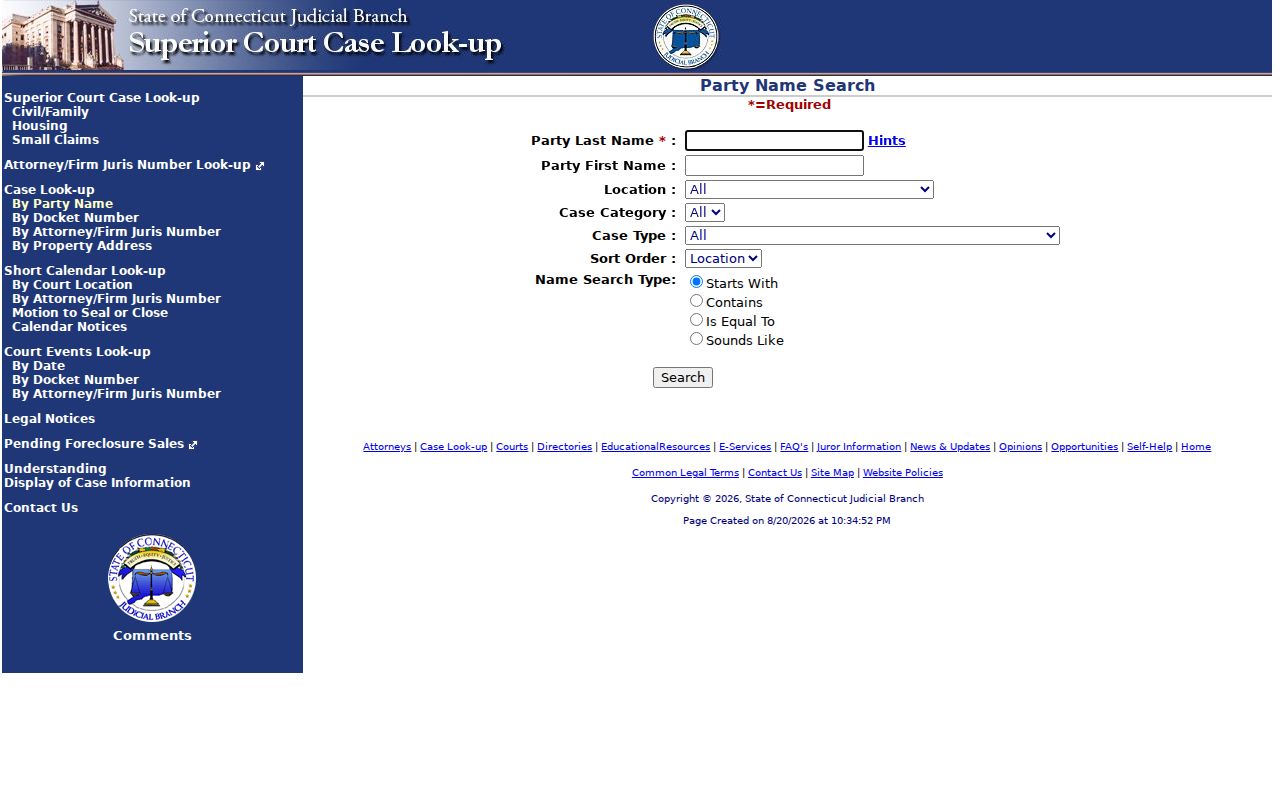
Any civil-search match needs care. Compare case date, location, party type, and name spelling before concluding the name belongs to the right Bloomfield resident.
Bloomfield Probate, Vital Records, and Family Ties
Probate answers a narrower question for the Bloomfield residents directory: does a name appear as an heir, fiduciary, guardian, conservator, trustee, or estate party? Bloomfield sits in Tobacco Valley Probate Court District 3. The court is based in Windsor Locks. The clerk's public number is 860-627-1450. The statewide lookup helps, though the public fields are dynamic and medical, minor, sealed, or confidential filings stay restricted. The Connecticut Probate case lookup is the right starting point for a possible estate connection.
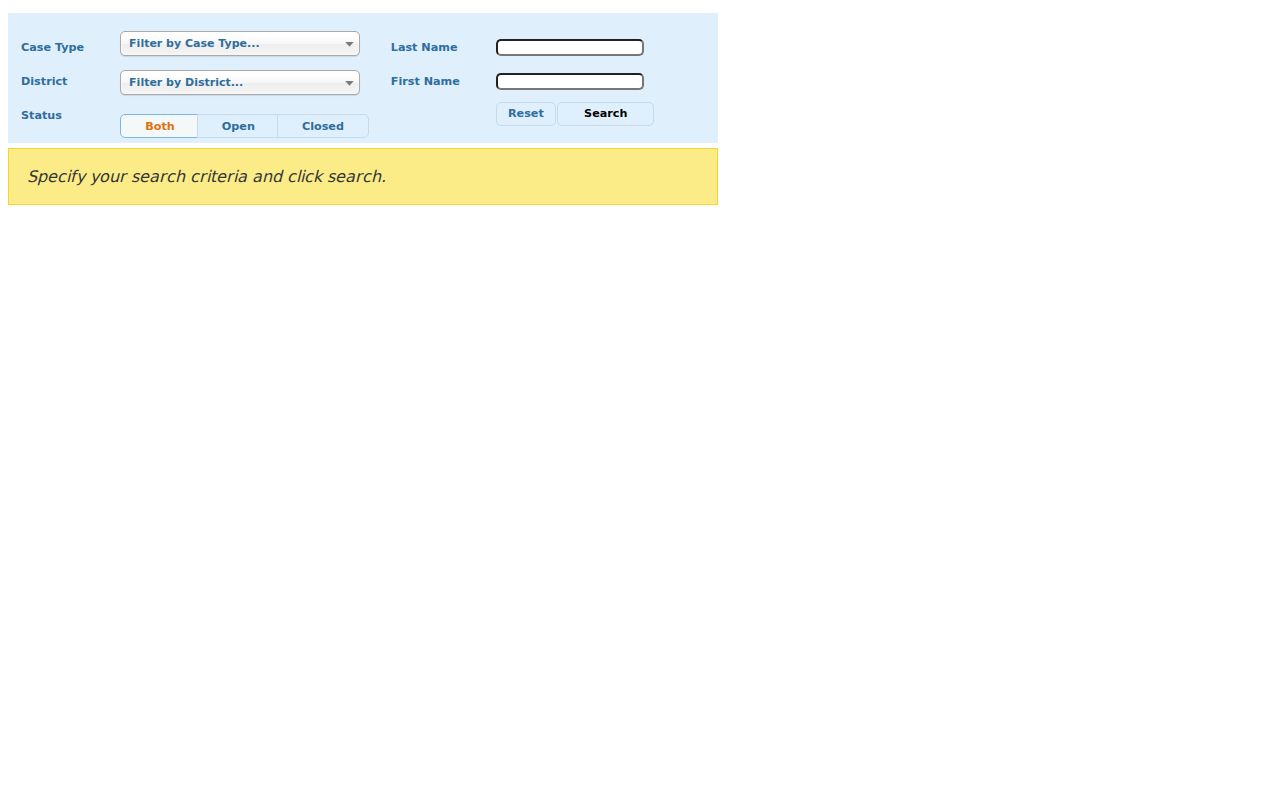
The probate image ties a resident lookup to the court district. A clerk file still settles family questions.
Vital records follow their own rules. Connecticut's statewide registry starts July 1, 1897. Birth records under 100 years stay restricted under CGS §7-51, while adults can generally obtain a certified death record through the proper route. Marriage access follows CGS §§7-51a and 7-74. Bloomfield lists a $50 marriage-license fee and a $20 certified copy. A divorce decree comes from the Superior Court, not the vital-record certificate office.
Birth-family research must use the official confidential route. Adoption files stay confidential. A public name search never replaces the DCF or Probate process, and DCF-3060, DCF-3061, and DCF-3062 support adult-adoptee information, contact preference, and reunion work. Certificates need the right records office. Bring the required form, identification, relationship, payment, and delivery route to the Bloomfield Town Clerk or the Connecticut DPH vital-records office.
Bloomfield License and Business Records
A credential or entity tie-in points the Bloomfield residents directory to Connecticut eLicense. It is a primary source. Visible fields include credential type and prefix, number, subcategory, status, business or DBA name, first and last name, address, state, city, ZIP, and country. The portal covers more than 850 credential types. Verification runs in real time. Options load after the page opens. Never infer a credential type the live form does not offer.
Business.CT.gov serves entity, annual filing, trademark, UCC, and certificate needs, but its online business search loads fields dynamically, so run the application directly and record what it returns. Bloomfield trade names stay a Town Clerk route. Use the counter or a targeted records request when no public index is posted.
CTBigList helps with heir or former-address questions. The state's unclaimed-property overview explains both purposes. The application accepts Last or Business Name, First Name, City, ZIP Code, or Property ID, and a result can show owner, address, holder, report year, property ID, and an amount band. The search is free. A claim still requires proof of identity or ownership through the State Treasurer's process.
The CTBigList claim-search application shows the name, city, ZIP, and property-ID choices. Use it for any lawful unclaimed-property search.
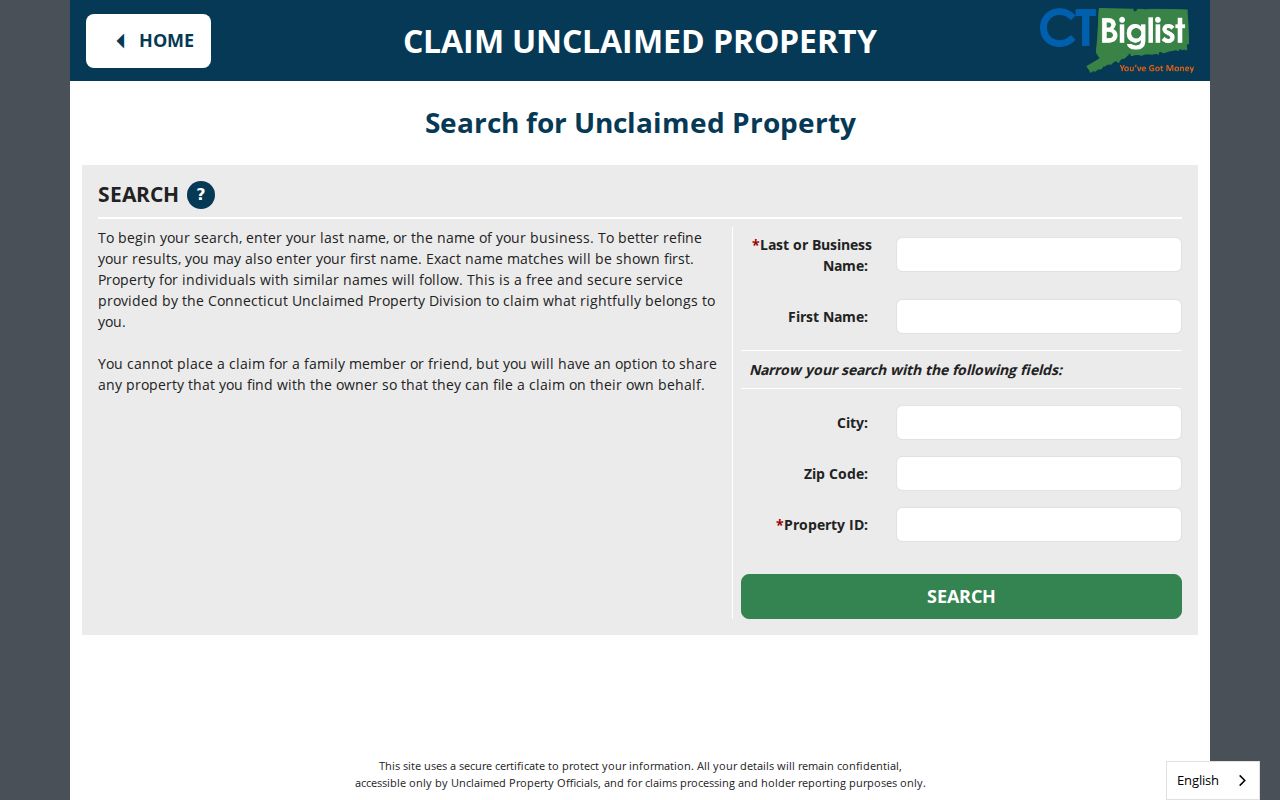
A possible match is only a lead. The Treasurer must still confirm the claim and the required proof.
Bloomfield Resident Court Results
A court result has a record shape. Read it field by field. Civil results can expose case name, case type, docket number, file or return date, court location, last action, party and appearance details, motions or pleadings, scheduled events, and disposition. Criminal dockets use a narrower name-and-court search. Federal matters belong in PACER, whose pricing guidance describes the $0.10-per-page charge, document caps, and quarterly waiver. Neither screen is a complete life history or a certified copy.
The criminal docket form searches a last name beginning with the entered text, an optional first initial, birth year, a year-range tolerance, court location, and a category such as criminal or motor vehicle. Bloomfield matters usually sit in Hartford Judicial District or Hartford Geographical Area 14. Results can change, though. Correction, erasure, pardon, sentencing updates, or release can alter a docket entry.
| Last Name | Begins-with search; spelling still matters |
|---|---|
| First Initial | Optional, one character |
| Birth Year | Optional, up to four digits |
| Year Range +/- | Optional tolerance around the entered year |
| Court Location | Choose Hartford Judicial District or the relevant geographic area |
| CategoryType | Criminal, motor vehicle, or related suspension category |
The Judicial Branch criminal docket search keeps the field set narrow. It covers the criminal side of a resident lookup.
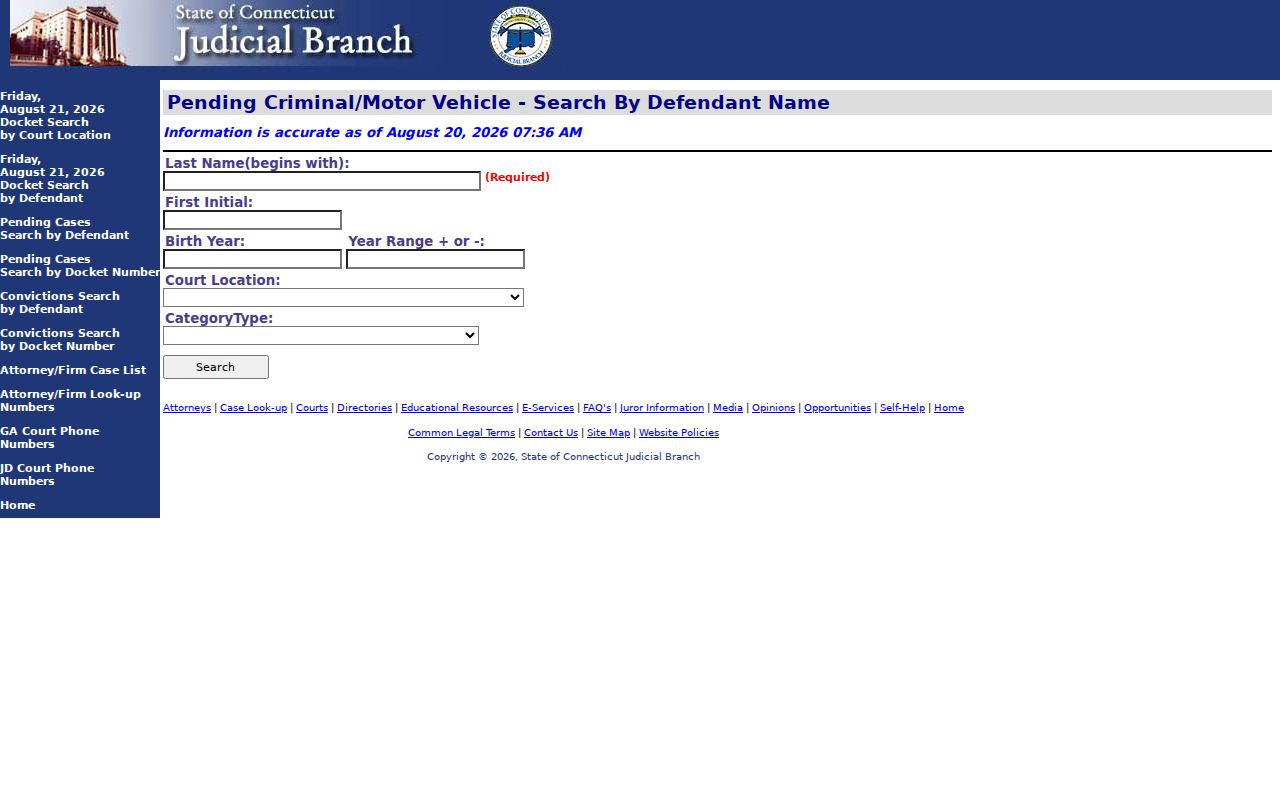
A Bloomfield resident lookup of court results only makes sense with context. The county criminal search screen shows the selected court, birth year, and date range behind each match. A blank result, or one that shifts after the filters change, does not settle anyone's history.
- Case header: case name, type, docket number, file date, and return date when public.
- Party and appearance: party name, role, attorney or self-represented appearance, and any public address field.
- Events: motions, pleadings, scheduled dates, last action, and event status.
- Disposition: disposition text, date, and judge or magistrate where shown.
- Visibility limits: sealed, juvenile, erased, protected-victim, and confidential family material may not appear.
Bloomfield Privacy and Resident Lookup Gaps
A blank line in a Bloomfield search is not always a gap. Connecticut's Address Confidentiality Program is known as Safe at Home. It gives a person a substitute mailing address. The real location stays protected in specified voter, marriage, and state or municipal records. A separate Voter Registry Privacy Program works differently. It lets a voter swear that disclosure would endanger the voter or family. That limits voter-registry disclosure. It creates no substitute address and suppresses nothing else.
The Connecticut Data Privacy Act grants certain rights over personal data. Those include access, correction, deletion, and portability. It also offers choices about sale, targeted advertising, and profiling by covered controllers. Still, none of that converts a municipal public record into a private one. Town Clerk, court, and voter obligations survive the statute. A correction request belongs with the custodian who created the record.
An official state criminal-history check runs by mail. It goes through the DESPP Bureau of Identification on form DPS-0846-C. The state page lists a $75 criminal-history check plus a $15 fingerprint fee when required. The wider State Police Reports and Records page handles accident summaries and other request channels. That route stands apart from a free court-name index. It is no shortcut around sealed or protected information. The Connecticut State Police Bureau of Identification spells out the official request route and its limits.
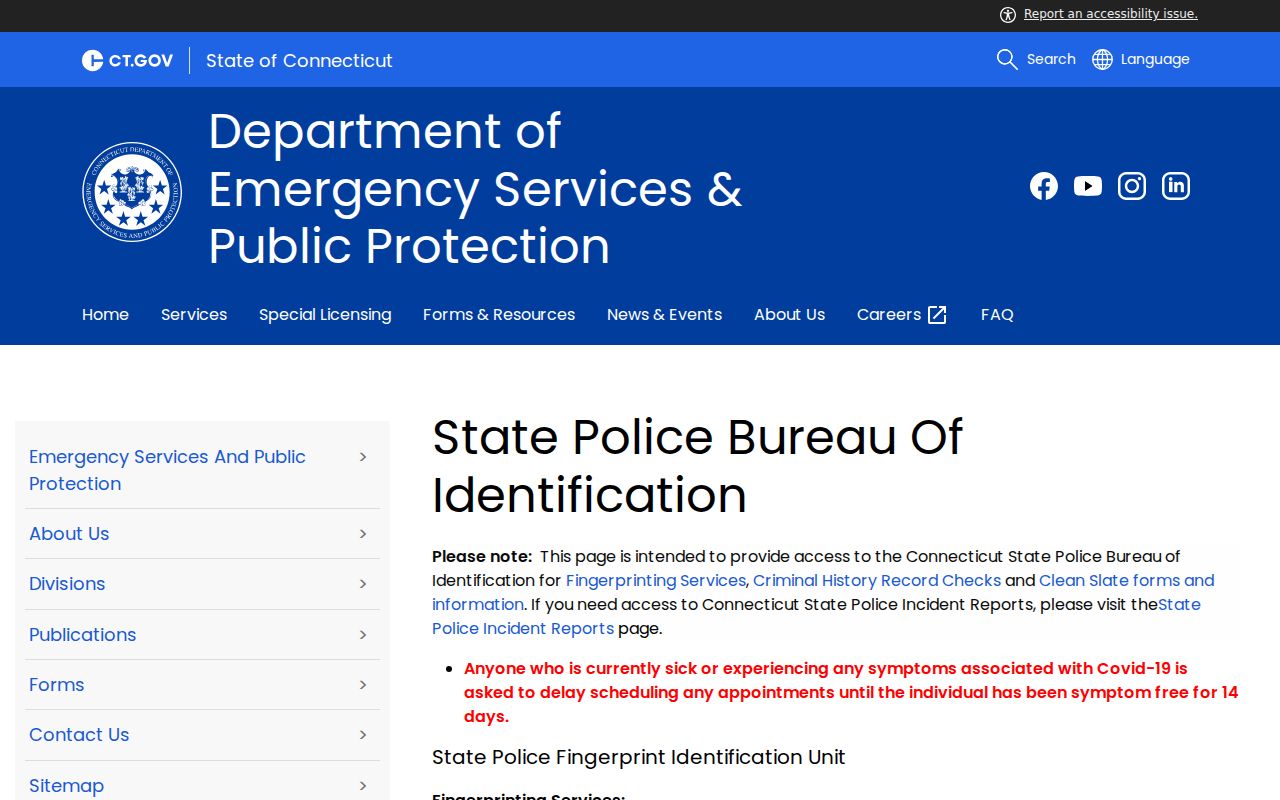
The state-records image illustrates a distinction worth remembering. A public court index, a mail request, and a record withheld by law are three different things.
Correcting a Bloomfield Record
If a name, address, or status in a Bloomfield record looks wrong, take it to the custodian. Don't copy the mistake into yet another lookup. The Assessor can sort out parcel identity. The Registrar of Voters handles registration corrections. The Town Clerk can explain a book, page, certificate, or trade-name entry. The court or probate clerk can explain access to the underlying file. A screenshot of a residents directory entry settles nothing; the office that keeps the record does.
Connecticut's Freedom of Information Act, Chapter 14, CGS §§1-200 through 1-242, stands as the fallback for non-exempt municipal records. A written request should name the custodian, describe the record, give the address or date range, and ask for electronic delivery. Request segregable or redacted material when that fits. The Town Clerk, Assessor, Engineering and GIS, Police Records, Building, and Registrar each hold a different piece of a Bloomfield record trail. Aim the request at the right office the first time.
The Bloomfield Police Records unit at 785 Park Avenue, 860-242-5501, takes written requests covering a location, record type, and time period. Disclosure limits and redactions are applied. For older names and addresses, the fallback chain runs from the BPL catalog and reference desk to the Wintonbury Historical Society. It then leads to the Connecticut State Library History & Genealogy Unit. The State Library sits at 231 Capitol Avenue in Hartford. It is open for research Monday through Friday from 10 a.m. to 4 p.m. History & Genealogy can be reached at 860-757-6580, and State Archives at 860-757-6511. A 2026 shelving notice makes a call before any trip worthwhile.
Keep the request narrow. Save proof of delivery. Ask which statute or rule controls any denial, since a targeted correction beats a demand for an entire personal file.
Lawful Limits on a Bloomfield Resident Lookup
A Bloomfield resident lookup fits family history, estate work, civic research, or reconnecting with someone. It works through an official route. Any personal, lawful purpose works. What the law forbids is different. Never publish sensitive identifiers. Never treat a same-name hit as a fact about a person. Never use a public record to monitor, threaten, intimidate, or repeatedly contact anyone. Connecticut stalking and harassment laws make misuse a serious safety issue.
Protective programs, sealed files, juvenile records, adoption records, erased matters, and restricted vital details all shape this records landscape. A blank result may protect someone. It may simply reflect a cutoff. Verify with the custodian when a decision turns on the record. Stop once the lawful purpose ends.
Lawful use. Bloomfield record searches are for personal, lawful research. Do not use records to stalk, harass, intimidate, or harm a person, and do not try to defeat a confidentiality program.